
You have a missing tooth, or your dentist says one may need to come out. One person recommends an implant. Another recommends a bridge. Both answers may be reasonable.
In my practice, I lean toward an implant when the neighboring teeth are healthy, the site can support it, and the patient is comfortable with surgery and a longer healing time. I consider a conventional bridge when the supporting teeth already need crowns, surgery isn’t suitable, or the patient wants a fixed tooth sooner. I can’t make that choice without examining the tooth, bite, gums, and bone.
Before we compare replacements, I ask: Can we save the tooth? My training in endodontics and implant dentistry means I consider root canal treatment and replacement before recommending an extraction. If I can restore the tooth with a predictable result, I don’t recommend removing it.
How I Compare An Implant And A Bridge
| Factor | Dental implant | Conventional dental bridge |
|---|---|---|
| Support | A post placed in the jawbone | Crowns on the teeth beside the gap |
| Surgery | Requires implant surgery | Does not require implant surgery |
| Neighboring teeth | Does not require reshaping healthy adjacent teeth | Requires reshaping the supporting teeth for crowns |
| Typical treatment time | Several months; longer with extraction healing or grafting | About two to four weeks after the teeth are ready for treatment |
| Missing-tooth bone | Replaces the root and transfers chewing force to the bone | Does not replace the missing root |
| Cleaning | Clean around the implant crown as an individual tooth | Clean under the false tooth and around both supporting crowns |
| Initial cost | Higher in many treatment plans | Lower in many treatment plans |
| Common reason to choose it | Healthy neighboring teeth and adequate bone | Supporting teeth already need crowns, or surgery is unsuitable |
This table compares two ways to replace one tooth. An implant-supported bridge, cantilever bridge, removable partial denture, or Maryland bridge works differently.
What Happens If You Leave The Gap?
Leaving the space open can change your bite. Nearby teeth can tip or drift. The opposing tooth can move into the space because it no longer meets a biting partner. Bone also shrinks after a tooth and its root are lost.
How much movement occurs depends on the location of the space and the patient’s bite. I examine both before recommending treatment. The FDA identifies rapid bone loss and changes in chewing as possible consequences of tooth loss.
What Implant Treatment Involves
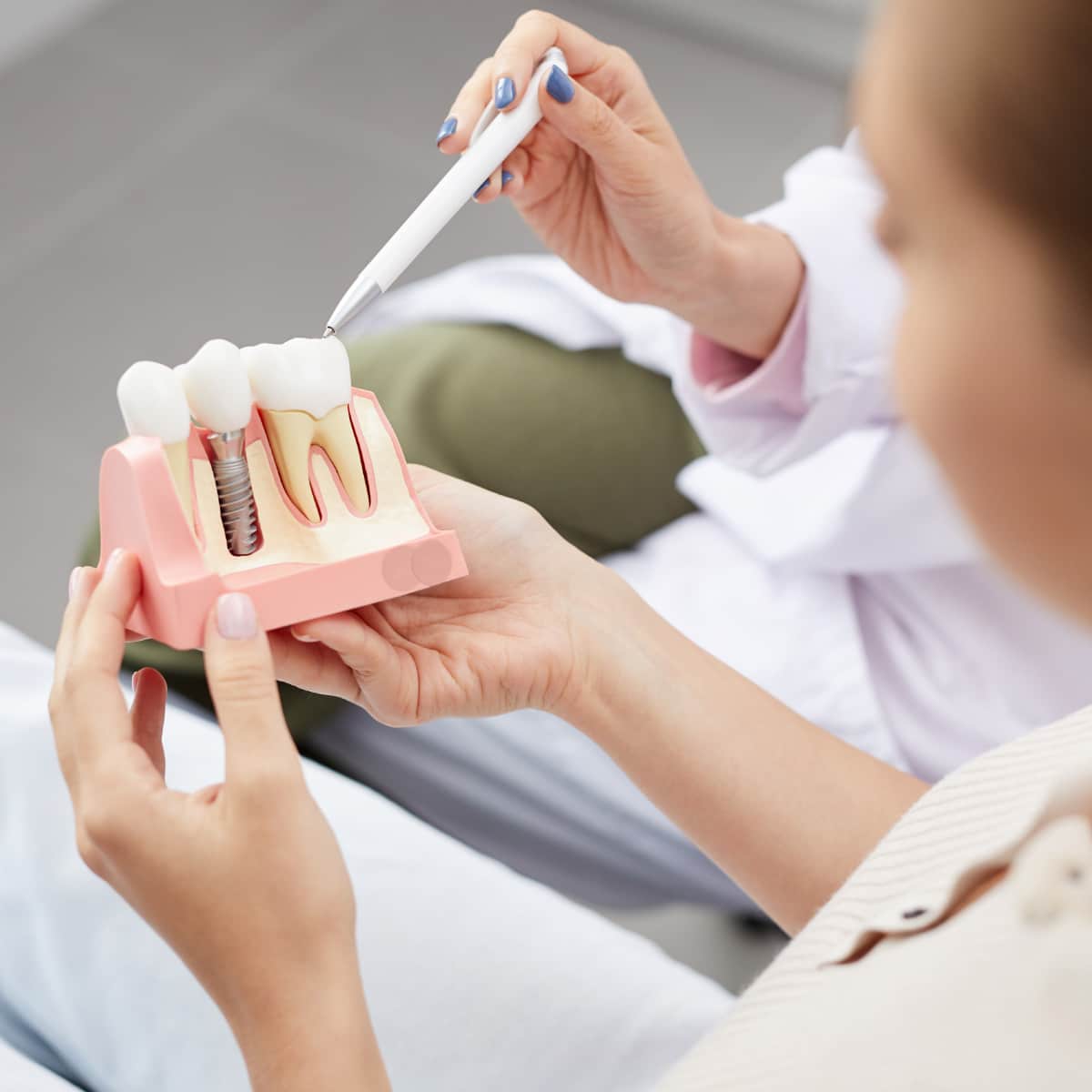
A single-tooth implant restoration has three parts:
- Implant fixture: The post placed in the jawbone.
- Abutment: The connector above the implant.
- Implant crown: The visible replacement tooth.
During the exam, I look at the bone and gums around the space. I also check the bite and review the patient’s medical history. Some patients receive an implant soon after extraction. Others need socket healing or a bone graft before implant placement.
Soreness, swelling, bruising, or minor bleeding can follow surgery. The implant then integrates with the bone. Healthdirect describes about three months of bone healing. The University of Illinois Chicago gives a broader range of 10 weeks to 12 months from placement through the final restoration. Grafting and complex sites take longer.
Patients usually want to know what they’ll wear while the implant heals. Depending on the tooth and the bite, I may use a temporary removable tooth, bonded tooth, bridge, or implant restoration. I choose the temporary to keep damaging pressure off the healing implant.
Implants need daily cleaning and professional maintenance. Smoking, poor plaque control, prior gum disease, and uncontrolled diabetes raise risk. The American Academy of Periodontology explains peri-implant disease risks. I cover these issues in more detail in our guide to dental implant risks and complications.
What A Conventional Bridge Uses For Support
A conventional bridge joins a false tooth, called a pontic, to crowns on the teeth beside the gap. I have to reshape those supporting teeth so the connected restoration fits over them. The American Dental Association describes how bridges restore appearance and function by using surrounding teeth for support.
A bridge stays in the mouth. You must clean beneath the pontic every day with a floss threader, interdental brush, or another suitable tool.
A conventional bridge generally takes two appointments. You’ll wear a temporary bridge over the prepared teeth while the laboratory makes the final one. Cleveland Clinic gives a fabrication time of two to four weeks.
What Can Go Wrong With A Bridge?
A bridge can loosen, chip, or fracture. Decay can form at a crown edge where it isn’t easy to see. If decay or a fracture damages one supporting tooth, I may have to remove the whole bridge. Losing that tooth changes the replacement plan.
A review of fixed bridge complications estimated 10-year risks of 9.5% for abutment decay and 10% for loss of pulp vitality. Those figures describe groups of patients, not what will happen to one person.
I Start With The Teeth Beside The Gap
When the teeth beside the space are sound, I prefer not to cut them down only to hold a bridge. An implant stands on its own. If one or both neighboring teeth already need crowns because of large fillings or fractures, a bridge may solve two problems in the same plan.
I also need to know whether the bone can hold an implant and whether the gums are stable. Some health conditions and medications affect surgical healing. The American Dental Association reports that implants are generally reliable in people with well-controlled diabetes. Poor control can delay healing and make the result less predictable.
For A Front Tooth, The Gum Line Changes The Plan
For a front tooth, the gum line matters as much as the crown. I look at the shape and color of the other teeth, the tissue between them, bone volume, gum thickness, implant position, and how much gum shows in the smile. Recession can expose part of an implant restoration.
A resin-bonded or Maryland bridge uses a wing bonded behind an adjacent tooth. It removes less tooth structure than a conventional bridge. It fits selected front-tooth cases with the right bite.
Back teeth face stronger chewing forces. For those teeth, I pay more attention to the bite, the length of the bridge span, implant position, available bone, and grinding habits.
What Changes The Cost Of Each Option?
An implant generally costs more at first because the plan includes surgery, components, and a crown. Extraction, grafting, a temporary tooth, and imaging add fees. A bridge generally costs less at first, but treatment for its supporting teeth changes the total.
When I compare implant vs bridge cost, I separate the plan into:
- Preparation, surgery, and grafting.
- The temporary and final restorations.
- Treatment needed for neighboring teeth.
- Expected maintenance and possible repairs.
- Insurance benefits and exclusions.
The practice accepts CareCredit and LendingClub financing. Approval and terms come from the financing provider. Review the practice’s current payment and insurance information, or call the office to confirm the options available for your plan.
How Long Can Each Option Last?
No restoration comes with a fixed expiration date. Service life changes with daily cleaning, bite forces, smoking, gum health, decay risk, and professional maintenance.
The systematic review cited in this article estimated 10-year survival of 89.4% for implant-supported single crowns and 87.7% for conventional tooth-supported fixed bridges. “Survival” means the restoration remained in use; it does not mean it needed no repair or maintenance.
Cleveland Clinic gives an average bridge lifespan of five to 15 years, with some lasting longer. I use that range for planning, not as a promise.
How Cleaning Differs At Home
I ask patients to clean an implant crown like an individual tooth while paying close attention to the gum line. A bridge requires cleaning around both supporting crowns and beneath the pontic. Both options need regular examinations so I can check the restoration, gums, bone, bite, and supporting teeth.
If implant placement is part of the plan, I will also determine whether guided or non-guided implant surgery is appropriate.
What Two Patients Said About Their Treatment Plans
These two patients describe issues I regularly discuss during treatment planning: trouble beneath an existing bridge, medical timing, bone loss, and a temporary front tooth during implant healing.
“Dr Kiser and his staff fully explained in great detail my issues are two teeth under a bridge. I will need to have them removed and a partial created. I can’t do anything for a few months for another medical reason. Dr. Kiser is so up to date on technology and medicines that affect gum healing.”
Laura Symsick
Read Laura’s review on Google
“When a front tooth snapped off damaging the structure, stem, and root, I carefully weighed options and decided to get a tooth implant after finding that I had bone loss too. Stephanie professionally and graciously helped me with an adjustment to a temporary tooth before the final on the implant.”
Thomas Adamescu
Read Thomas’s review on Google
These reviews describe individual patient experiences. Treatment needs, comfort, timing, and results vary.
What About A Removable Partial Denture?
A removable partial denture can replace one or several teeth without implant surgery or a conventional bridge. You take it out for cleaning. It generally costs less at first, but it doesn’t feel or function exactly like a fixed restoration. Before recommending one, I explain where the clasps and coverage will sit, how much movement to expect, and when adjustments may be needed.
Frequently Asked Questions
Is A Dental Implant Always Better Than A Bridge?
No. The right option depends on whether the tooth can be saved, the condition of the neighboring teeth, bone and gum health, medical risk, bite forces, treatment time, and the patient’s priorities.
Can A Bridge Be Placed Without Grinding Down Healthy Teeth?
A conventional bridge requires reshaping its supporting teeth for crowns. A Maryland bridge uses one or more bonded wings and removes less tooth structure, but it fits only selected cases. Implant-supported and cantilever bridges follow different designs.
Do Dental Implants Stop Bone Loss?
An implant replaces the root and transfers chewing force to the surrounding bone. That helps preserve bone at the site, but it does not guarantee that bone loss will never occur. Inflammation, implant position, smoking, bite forces, and medical risks still matter.
Can I Get An Implant If I Have Diabetes?
Many people with well-controlled diabetes qualify for implants. Poor control can delay healing. I review the patient’s health and may coordinate with the treating physician before surgery.
Which Is Easier To Clean, An Implant Or A Bridge?
A single implant crown is cleaned as an individual tooth. A bridge requires an extra step beneath the pontic. The exact tools depend on the restoration and the patient’s dexterity.
How Do I Know Whether I Need A Bone Graft?
I assess the height, width, and shape of the bone with an examination and dental imaging. Previous infection, gum disease, injury, and natural anatomy can leave too little bone for an implant in the planned position.
Is An Implant-Supported Bridge More Expensive Than A Traditional Bridge?
It generally has a higher initial cost because the treatment includes implant surgery, implant components, and the bridge. The comparison must also include grafting, the number of implants, the condition of the natural teeth, and maintenance.
Get A Written Plan For Your Tooth
At Advanced Dentistry & Dental Implant Center in Mansfield, Ohio, I first determine whether the tooth can be saved. If it can’t, I’ll show you which replacement options fit the condition of the nearby teeth, bone, and gums. We’ll also account for your bite, health history, schedule, and maintenance needs.
Russell Kiser II, DDS, MS, EMT-P, ABOI/ID, has training in endodontics and implant dentistry.
Request an evaluation to review the suitable options, treatment stages, timeline, and fees for your tooth, or call 419-756-2880. Ask the office for a written comparison of the plans you discuss.
This article provides general educational information and does not replace an examination, diagnosis, or individualized treatment plan.
Related Posts
- What Happens During a Bone Grafting Procedure for Dental Implants?: See why grafting may be recommended before implant placement and how it can affect the treatment timeline.
- Guided vs. Non-Guided Dental Implant Placement Surgery: Compare two approaches to implant placement and the factors that influence which method may be used.
- Dental Implant Risks and Problems Involved: Review biological and mechanical complications before deciding whether implant treatment fits your situation.
- How All-on-4 Dental Implants Help Prevent Bone Loss: Explore a fixed full-arch option when several failing or missing teeth are involved.